
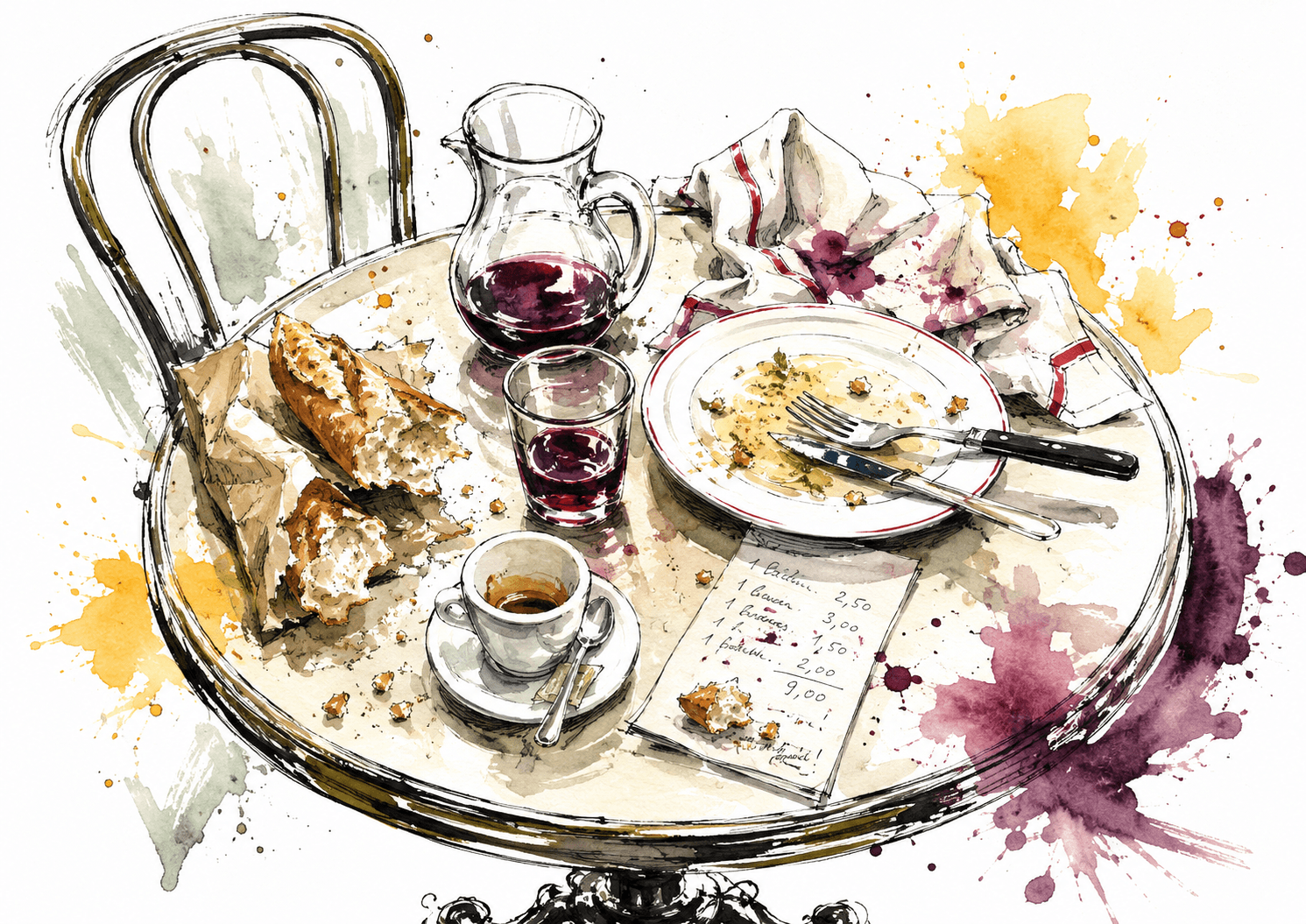
My Parisian wife taught me many things about eating in France, but the most dangerous lesson was this: never trust a restaurant just because it looks beautiful.
The best meals rarely happen where the tables are perfect and the waiters are young.
They happen in places with fogged-up windows, laminated menus, handwritten specials, tired regulars, and one dish that everyone in the room seems to understand before you do. The sort of place you might walk past twice because it looks too ordinary, too scruffy, too unbothered by your expectations.
In French, there is a word for these places: un boui-boui.
And if you want to eat cheaply in Paris without feeding yourself to the tourist-trap machine, you need to learn how to find them.
This is not another list of cheap restaurants in Paris. If you want the full survival kit — bakeries, markets, formules, and budget food tactics — start with my full chef’s guide to eating cheaply in Paris. This article is about something narrower, stranger, and possibly more useful.
This is about learning how to read the room.
Table of Contents
What Does Boui-Boui Mean in French?
A boui-boui — sometimes written bouiboui — is not supposed to sound glamorous.
Le Robert defines it as a familiar word for a low-end café or restaurant. Larousse gives it that same rough flavour: a mediocre café, restaurant, cabaret, or gargote. Delicious word, gargote. It sounds like somewhere you might eat too quickly with your elbows out and leave smelling faintly of frying oil and victory.
Traditionally, boui-boui is pejorative. It means a dive. A cheap little joint. Somewhere a bit rough. Possibly somewhere your mother-in-law would describe with pursed lips and a tight little “hmm.”
But food people are terrible for this sort of thing. Give us a supposedly negative word and we will reclaim it if the food is good enough.
Because a proper boui-boui is not just a bad restaurant.
A proper boui-boui is a place that does not waste energy looking polished because it is too busy feeding people.
It might be a tiny Vietnamese canteen. A North African couscous spot. A worker’s café with a lunch formula that has not changed much since the last republic. A steamy noodle counter. A Turkish grill. A Sri Lankan place near a station. A bakery where the sandwich is better than half the brasseries charging three times the price.
It is not elegant. It is not always photogenic. It probably does not have a press release.
Good.
Cheap Eats in Paris Are Not Just About Being Cheap
Let’s get this out of the way: cheap food can be bad.
Paris has plenty of miserable cheap meals. Dry sandwiches. Grey crêpes. Sad reheated duck confit. Pasta with all the emotional range of wet cardboard. Places where “traditional French cuisine” is written in six languages and every dish arrives tasting faintly of freezer burn and regret.
So no, this is not about being cheap for the sake of it.
The real French idea you want is rapport qualité-prix — value for money. Not the lowest price. The best relationship between what you pay and what lands in front of you.
If you want the broader strategy, I’ve written a full guide on how to eat in Paris on a budget without getting played. Bouibouitologie — yes, we are getting to that ridiculous word — is the scruffier, more instinctive cousin of that idea.
It is about asking:
- Does this place feed real people?
- Does it have a rhythm?
- Does the room make sense?
- Is there one thing here that everyone knows to order?
- Does the price feel fair for the care, generosity, and pleasure on the plate?
That is the game.
My Parisian Wife Taught Me to Read the Room First
Before I lived in France properly, I still had too much faith in restaurant surfaces.
Nice chairs. Good lighting. A menu that looked designed. A dining room with just enough vintage clutter to whisper “authentic” while quietly charging you €19 for three leaves and a drizzle.
My wife saw through that nonsense much faster than I did.
She would pause outside a restaurant and do this tiny assessment. Not dramatic. Not tourist-with-TripAdvisor energy. Just a quick Parisian scan.
Who is eating there?
Are they comfortable?
Are they regulars?
Is the room too empty for the time of day?
Is everyone eating the same thing?
Does the waiter look bored, frantic, or quietly in control?
Does the place smell like stock, frying onions, grilled meat, coffee, butter and steam — or just cleaning spray and desperation?
That, I slowly realised, was the art.
Not finding the place everyone on Instagram had already found. Not chasing “hidden gems” as if Paris were a video game full of edible treasure chests. Just learning how to see the places that were already there, doing their job, feeding their people.
The best cheap eats in Paris are rarely hidden.
They are just happening without you.
What Is a Bouibouiste?
A bouibouiste is not an official job title.
Sadly.
But it should be.
A bouibouiste is someone who hunts for these places. Someone who would rather find a brilliant €6 banh mi, a proper couscous, a worker’s lunch, a steamy noodle shop, or a half-hidden bistro than pay €28 for a sad croque monsieur within sniffing distance of a monument.
It is a playful word, built from boui-boui with that very French-feeling -iste ending — like gastronome, épicuriste, survivaliste, or any other person who has turned an obsession into a personality flaw.
And the practice itself?
Obviously: la bouibouitologie.
The completely unofficial art of finding ugly little restaurants with exceptional food.
Part instinct. Part appetite. Part nosiness. Part refusal to be seduced by beige interiors, QR-code menus, and restaurants that have spent more money on their typography than their stockpot.
The People Already Practising Bouibouitologie
I did not invent this obsession.
Paris already has a small, hungry tribe of people who have spent years documenting the kind of places that do not look like much but feed the city beautifully. If you want to understand bouibouitologie properly, these are the voices worth knowing.
Chloé Vasselin, behind the excellent Boui-Boui project, treats these places as more than cheap restaurants. Her work is about food, migration, neighbourhoods, family cooking, and the cultures that make Paris taste much bigger than France. Her book, Guide du Paris Boui-Boui, gathers low-cost addresses discovered through years of wandering the city. It is basically a love letter to the edible backstreets of Paris. Check out her site.
Then there is Anaïs Lerma of Parisianavores, who has probably done more than most people to give the Paris boui-boui its proper dignity. Her guide, Bouis-bouis, cantines, bistrots: Bien manger à Paris à moins de 15€, focuses on places where you can still eat well in and around Paris for under €15: Asian cantines, African restaurants, Mediterranean counters, neighbourhood bistros, and all the “ça ne paie pas de mine mais…” rooms where the food does the talking. Check out her book.
That phrase matters: ça ne paie pas de mine.
It means “it doesn’t look like much.”
That is almost the boui-boui motto.
You will also find street-food critics and scouts — people like Mina Soundiram — who helped make it normal to talk about cantines, counters, buns, noodles, snacks, kebabs, sandwiches, and tiny specialist places with the same appetite usually reserved for tasting menus.
That matters too.
Cheap food deserves proper criticism. A €7 sandwich can be brilliant or insulting. A €12 lunch can tell you more about a neighbourhood than a €140 menu designed for people who collect restaurants like watches.
You will also find plenty of “best boui-boui” lists online now. Some are useful. Some are SEO confetti with chilli oil on top. But a list is never enough in Paris, because restaurants change, owners change, prices change, and TikTok can ruin a good room in a fortnight.
The better skill is learning how to spot the signs yourself.
Read the lists. Follow the accounts. Buy the books if this kind of eating excites you.
But do not just copy-paste addresses into Google Maps and call it expertise.
The real lesson is the method: follow communities, look for repetition, understand neighbourhood rhythm, respect small restaurants, and pay attention to who the place is actually feeding.
Paris Food Tours
Eat Paris beyond the landmarks
Skip the tourist-trap theatre. Taste the markets, bakeries, bistros—no fluff. Just the food that actually matters.
Book a Paris Food Tour →How to Spot a Proper Boui-Boui in Paris
There is no perfect formula, because the whole point is that these places rarely behave like polished restaurants.
But there are signs.
1. Look for places that serve a real purpose
A proper boui-boui usually exists because people need it.
Workers need lunch. Students need something filling. Neighbours need a place where they can eat without thinking too much. Families need somewhere generous. Taxi drivers need somewhere fast. Regulars need somewhere familiar.
This matters.
A restaurant that serves a real purpose has rhythm. It fills at certain times. It has a dish people know to order. The staff may not be charming in the performative tourist sense, but they know what they are doing.
Good signs include:
- workers eating quickly at lunch
- regulars greeted without ceremony
- a short menu or one obvious speciality
- people eating alone without looking awkward
- a room that feels useful rather than staged
- a dish of the day that half the room has ordered
Bad signs include:
- a menu trying to please everyone
- photos of every dish outside
- staff pulling tourists in from the pavement
- “traditional French cuisine” written in six languages
- onion soup, snails, duck confit, burgers, pizza, Caesar salad and poke bowls all living unhappily on the same menu
Paris is very good at performing Frenchness back at visitors.
Red awnings. Fake nostalgia. Perfect rattan chairs. A menu that looks like it was assembled by someone who has never eaten lunch with a plumber.
Some of those places are fine.
Many are expensive theatre.
A boui-boui has no time for theatre. It is too busy feeding people.
If you want the brutal version of this — fake cooking, factory-made dishes, and restaurants performing Frenchness for tourists — read my guide on how to find real local food in Paris. A proper boui-boui is usually the opposite of that nonsense: useful, human, imperfect, and alive.
2. Follow the rhythm, not the décor
Paris eats in rhythms.
Lunch is not dinner. Monday is not Saturday. A bakery at 12:45 is a different beast from a bakery at 16:30. A market street before noon has a different pulse from the same street at 3pm when everyone is dragging crates and the romance has been hosed into the gutter.
A bouibouiste pays attention to timing.
Lunch formulas matter. Bakeries matter. Market-adjacent cafés matter. Train-station neighbourhoods matter, but only if you know what to avoid. Student areas matter. The outer arrondissements matter. So do the communities that have built their food lives in Paris without waiting for permission from glossy magazines.
This is why some of the best affordable food in Paris is not “classic French” at all.
It is Vietnamese, Algerian, Moroccan, Turkish, Lebanese, Sri Lankan, Cambodian, Senegalese, Japanese, Chinese, Kurdish, Portuguese, Tunisian, Colombian, Greek, Armenian, Ethiopian, and everything else this city eats when it is not pretending to be a postcard.
The boui-boui is one of the best ways to understand Paris as it actually tastes.
Not just baguettes and boeuf bourguignon.
A city of workers, migrants, students, families, bakers, aunties, grill masters, noodle pullers, sandwich makers, market traders, and tired people who still need lunch.
3. Judge the room before the menu
This is the lesson my wife drilled into me.
The menu lies.
The room usually tells the truth.
Before you sit down, look around.
Who is eating?
Are they locals, workers, students, regulars, families, older people, people eating alone, people who look comfortable enough to ignore the room completely?
What are they eating?
Is there one dish that keeps appearing?
Is the waiter carrying plates with confidence or confusion?
Does the food smell like it has actually been cooked somewhere nearby?
Does the place feel dead at a time when it should be alive?
You are not looking for perfection. You are looking for evidence of use.
A good boui-boui often feels a bit worn because people actually use it.
Chairs get scraped. Tables wobble. Menus get handled. Sauces leave ghosts. The room carries the memory of meals.
That is different from dirt. Different from neglect. Different from “we haven’t cleaned the fryer since Sarkozy.”
You are looking for patina, not biohazard.
Important distinction.
4. Order what the place wants you to order
One of the easiest ways to eat badly in Paris is to order against the identity of the restaurant.
Do not go into a couscous place and order a salad because you are “just being light.”
Do not go into a banh mi shop and start interrogating the dessert menu.
Do not sit in a bouillon and expect spiritual transcendence from a side salad.
A good cheap restaurant usually has a centre of gravity.
Find it.
In a Vietnamese spot, it might be the banh mi, pho, bo bun, or one particular rice plate everyone seems to know. In a North African place, it might be couscous on the right day, grilled meat, chorba, or bricks. In a bakery, it might be the simplest sandwich in the window. In a worker’s café, it might be the plat du jour. In a crêperie, it is probably not the “Tex-Mex special.”
Order the thing that makes sense.
If half the room is eating the same dish, do not try to be clever.
Being clever is how you end up paying €17 for sadness.
5. Beware “cheap” places built for tourists
Cheap-looking does not mean local.
A place can be ugly and still be a trap. In fact, some tourist traps are ugly in the most cynical way: laminated menus, microwaved classics, bored staff, sticky tables, dead fries, and a business model built on the fact that you will never come back.
The warning signs are usually obvious once you stop being hungry enough to ignore them.
Huge menu.
Every dish available all day.
Photos outside.
Aggressive staff.
No rhythm.
No regulars.
No smell of cooking.
No dish that seems to matter.
A room full of people all looking faintly disappointed in different languages.
Of course, not every cheap place is a hidden gem. Some are just bad. For a deeper hit list of warning signs, read my guide on how to avoid tourist food in Paris.
Where to Look for Boui-Bouis in Paris
I am not going to turn this into a sacred list of addresses, because that misses the point.
Also, the second you publish a list, someone changes the chef, doubles the prices, gets famous on TikTok, or closes for mysterious “travaux” that last longer than most marriages.
But there are types of places and neighbourhoods worth exploring.
Look around train stations, but carefully. Gare du Nord and Gare de l’Est are chaotic, yes, but they are also surrounded by real food cultures. You can eat terribly there if you follow the wrong signs, and beautifully if you follow the right ones.
Look in student areas. Students are excellent pressure on a neighbourhood because they need food that is cheap, filling, and not always depressing.
Look around market streets. Not the polished ones only. The useful ones. Streets where people buy, snack, gossip, queue, and disappear into tiny places at lunchtime.
Look beyond the postcard arrondissements. The 10th, 11th, 13th, 18th, 19th, and 20th are full of affordable food stories. So are the suburbs, if you are willing to stop treating the périphérique like a medieval city wall.
And yes, look in Boulogne-Billancourt too. I live out west, and one of the quiet pleasures of the suburbs is that restaurants often have to serve repeat customers, not just passing tourists with romantic damage and hotel keycards.
If you want a shortcut, I keep an evolving Paris food map for local eats — the kind of places I would actually send hungry friends, not just SEO traffic.
My Boui-Boui Rules for Eating Cheaply in Paris
Here is the working doctrine.
If the menu is laminated but short, I am listening.
If the waiter looks tired but the regulars look fed, good sign.
If nobody is posing, even better.
If the dish of the day is under €15 and half the room ordered it, pay attention.
If the restaurant clearly does one thing better than everything else, order that.
If the room smells like real cooking, stay.
If the place looks too perfect, ask who it is perfect for.
If my wife gives the tiny nod, we are going in.
The Boui-Boui Mindset
The art of the boui-boui is not about fetishising poverty, romanticising exhaustion, or pretending every scruffy little restaurant is secretly brilliant.
That would be stupid.
Some scruffy restaurants are scruffy because they are bad.
Some cheap restaurants are cheap because nobody cared enough to make them good.
Some “authentic” places are only authentic in the sense that the microwave is authentically tired.
The point is not to worship ugliness.
The point is to stop confusing polish with pleasure.
Paris will happily sell you a mediocre meal in a beautiful room. The trick is learning when to ignore the room — and when to listen to it more carefully.
A proper boui-boui has signs of life. It has purpose. It has repetition. It has people who come back. It has a dish, a rhythm, a smell, a reason.
It feeds before it performs.
And that, increasingly, is rare.
Become a Bouibouiste
So yes, Paris is expensive.
Yes, you can get mugged by a bad croque monsieur within smelling distance of the Eiffel Tower.
Yes, some restaurants here are selling theatre, nostalgia, and industrial mush at prices that make you want to throw a baguette through a window.
But you can also eat beautifully, generously, and cheaply if you learn to look past perfection.
My Parisian wife taught me this art. I am still learning. I still get it wrong. But every now and then, I find a place with battered tables, grumpy charm, a handwritten special, and a plate of food that makes the city feel human again.
That is the boui-boui life.
And if you are hunting for those places too, congratulations.
You might be a bouibouiste.
Want to learn how to read the city with your stomach? Join a chef-led Paris food tour and I’ll show you how to spot the good stuff before the menu even lands on the table.
Love this? Get more real, unfiltered food stories straight to your inbox. No fluff, no spam—just damn good food writing and all for free!

From the bustling streets of Paris to the heat of a professional kitchen, my life has always revolved around food. A Brit who moved to France at 16, I trained as a chef in a Parisian palace kitchen at 18 and have spent decades cooking, eating, and living like the French.
By day, I run kitchens and events, but Eat Like The French is my side hustle—a way to share my passion for French food through writing and food tours. After a detour into tech recruitment, I returned to what I love most: cooking and storytelling—one dish, one tour, and one bite at a time.
Cheap Eats & Boui-Boui FAQ
What does boui-boui mean in French?
A boui-boui, sometimes written bouiboui, is a familiar French word for a rough, low-end café, restaurant, cabaret, or dive. It is traditionally pejorative, but food lovers sometimes use it affectionately for scruffy places that serve surprisingly good food.
Is boui-boui a compliment?
Not traditionally. In standard French, it suggests somewhere mediocre or questionable. But context matters. Among food obsessives, calling somewhere a great boui-boui can be a compliment: it means the place is unpolished, useful, and delicious.
What is a bouibouiste?
A bouibouiste is a playful, unofficial word for someone who loves hunting down boui-bouis: cheap, chaotic, useful little restaurants where the food is better than the décor.
What is bouibouitologie?
Bouibouitologie is a mock-serious word for the art of finding good boui-bouis. Think of it as the study of scruffy restaurants, cheap eats, regulars, lunch rhythms, and the tiny clues that tell you whether a place actually feeds people properly.
Can you eat cheaply in Paris and still eat well?
Yes, but you need to avoid the obvious tourist menus and learn to follow local rhythm. Look for lunch formules, bakeries, markets, bouillons, community restaurants, specialist canteens, and places with regulars rather than places built only for visitors.
What are the best cheap foods to eat in Paris?
Good cheap eats in Paris include bakery sandwiches, banh mi, falafel, couscous, bouillon classics, crêpes, market lunches, Asian canteens, plat du jour lunches, and simple dishes in neighbourhood cafés.
How do I avoid bad cheap restaurants in Paris?
Avoid huge menus, aggressive street touts, food photos outside, tourist-heavy streets with identical menus, and places where every dish seems available all day. Cheap food can be brilliant, but only when the place has rhythm, focus, and regular customers.